I Tested the Ecotank Et 4800 for a Month: Here is My Verdict
The printer market has undergone a significant transformation over the last decade. For years, the industry followed a "razor and blade" business model, where the hardware was sold at a loss or thin margin, and the manufacturer recouped costs through high-priced, proprietary ink cartridges. However, with the rise of remote work and the increasing demand for sustainable, high-volume printing solutions, the tank-based system has become the gold standard for home offices and small businesses. Among the frontrunners in this category is the Epson EcoTank ET-4800, an entry-level all-in-one printer that promises to trade the convenience of cartridges for the longevity of ink tanks. After thirty days of rigorous testing—ranging from heavy document printing to scanning multiple receipts and sending occasional faxes—here is an exhaustive verdict on whether this machine lives up to the hype.
The EcoTank ET-4800 is positioned as a versatile workforce tool. It is designed for those who find themselves constantly running to the store for expensive replacement cartridges or those who have become frustrated with the waste associated with traditional inkjet printing. While it sits at a higher initial price point than many cartridge-based competitors, the value proposition lies in its operation costs. Over the course of a month, this review examines every facet of the machine, from the initial setup and ink-filling process to the quality of the PrecisionCore printhead and the reliability of the ADF (Automatic Document Feeder).
The Evolution of the Home Office Printer
Before diving into the specifics of the ET-4800, it is essential to understand why this specific model matters. In the current landscape, electronics buyers are prioritizing two things: efficiency and eco-friendliness. The ET-4800 addresses both by utilizing large, refillable ink reservoirs rather than small, plastic-heavy cartridges. In a typical home office setting, a standard cartridge might yield 200 to 300 pages. In contrast, the bottles supplied with the ET-4800 are advertised to last for thousands of pages. For the user, this means fewer interruptions and a significantly lower cost per page (CPP). This shift from a "disposable" mentality to a "refillable" one is the primary reason why the EcoTank series has become a staple in the electronics category.
Initial Setup and the Filling Experience
One of the most intimidating aspects of moving to a tank-based system is the fear of making a mess. Traditional inkjet users are accustomed to clicking a plastic cartridge into place. The ET-4800 requires the user to manually fill four separate tanks (Black, Cyan, Magenta, and Yellow) from bottles. During the first week of testing, the setup process was scrutinized for its level of user-friendliness. Epson has engineered a "Keyed" bottle system, which ensures that a Cyan bottle can only fit into the Cyan tank, preventing accidental color mixing. The bottles are also designed with a vacuum-pressure valve that stops the flow of ink once the tank is full, preventing overflows.
The process is surprisingly clean. After filling the tanks, the printer undergoes an "initialization" phase that takes approximately ten minutes. This is where the ink is pulled through the internal tubing into the printhead. Once initialized, the software setup can be handled via a USB connection, Ethernet, or Wi-Fi. The Epson Smart Panel app was utilized extensively during the test month, allowing for setup via a smartphone. While the small 1.44-inch non-touch display on the printer itself feels somewhat dated in an era of large tablet-like interfaces, the mobile app compensates for this by providing a robust, modern control center.
Detailed Performance Analysis
Print Quality: Text and Graphics
The ET-4800 utilizes Epson’s MicroPiezo heat-free technology. Throughout the month, the printer was tasked with producing standard text documents, colorful PowerPoint presentations, and the occasional high-resolution PDF. For monochrome text, the ET-4800 is exceptional. Characters are sharp, and even at small font sizes (4pt or 5pt), there is minimal feathering. This makes it an ideal choice for legal documents, academic papers, and invoices.
When it comes to color graphics, the results are balanced but not professional-grade for photography. Because the ET-4800 is designed as an office tool rather than a dedicated photo printer (which often use five or six colors for better tonal range), color prints on standard paper are vibrant but lack the "pop" found in higher-end models. However, when using high-quality inkjet paper or matte presentation paper, the performance improves significantly. It is perfectly adequate for internal business reports and marketing flyers but should not be the primary choice for professional photographers.
Speed and Throughput
In a month-long test, speed becomes a critical factor, especially when printing 50-page reports. The ET-4800 is rated at 10 pages per minute (ppm) for black and 5 ppm for color. In real-world testing, these figures held true. While these speeds are slower than laser printers or the more expensive ET-5800 series, they are sufficient for a single-user home office. The lack of automatic duplexing (two-sided printing) is perhaps the most notable omission. Users must manually flip the pages if they want to print on both sides. In a professional setting where time is money, this could be a dealbreaker, but for many home users, it is a manageable trade-off for the ink savings.
Shop the latest Electronics picks on Amazon.
Browse Now →Scanning and Copying
The 30-sheet Automatic Document Feeder (ADF) was tested with various paper weights and conditions, including slightly crinkled receipts. The ADF simplifies the task of scanning multi-page documents to a computer or cloud service. The scanning resolution of 1200 x 2400 dpi ensures that digital copies are crisp and professional. One significant advantage observed during the month was the integration with the Epson ScanSmart software, which allows for easy OCR (Optical Character Recognition), turning scanned PDFs into searchable text. This is a feature often overlooked by buyers but highly valued by anyone trying to digitize their paper filing system.
Real-World Use Cases
To provide a comprehensive verdict, the ET-4800 was deployed in three distinct scenarios during the month of testing: the remote professional, the student, and the small business owner.
The Remote Professional: For the professional who prints 20 to 50 pages a week, the ET-4800 is a "set it and forget it" machine. The Wi-Fi Direct capability proved useful when the main router was under heavy load, allowing the laptop to connect directly to the printer. The reliability of the connection was a highlight; there were no instances of the printer "disappearing" from the network, a common frustration with cheaper wireless printers.
The Student: High-volume printing is common for students who need to print out long research papers or reading materials. During the test, we p…
The Small Business: The inclusion of Ethernet and Fax capabilities makes the ET-4800 a viable choice for small retail or service businesses. While faxing is becoming less common, certain industries (legal, medical, and construction) still require it. Having a dedicated fax line integrated into an EcoTank system provides a level of versatility that many modern "sleek" printers have abandoned.
Pros and Cons
- Extremely Low Running Costs: The replacement ink bottles are significantly cheaper than cartridges, leading to a cost-per-page that is hard to beat in the inkjet market.
- Generous Initial Ink Supply: The box includes enough ink to last many users up to two years, meaning no additional purchases are required immediately after the initial investment.
- Reliable Connectivity: Support for Ethernet, Wi-Fi, and Wi-Fi Direct ensures the printer fits into any modern network environment.
- Compact Footprint: Despite having large ink tanks, the design is surprisingly compact and fits easily on a standard desk or shelf.
- User-Friendly Mobile App: The Epson Smart Panel app is well-designed and simplifies many complex tasks like head cleaning and cloud scanning.
- No Automatic Two-Sided Printing: Missing auto-duplexing is the biggest drawback, requiring manual intervention for double-sided documents.
- Basic Control Panel: The small, non-touch LCD screen feels dated and can be difficult to navigate for complex settings.
- Paper Capacity: The 100-sheet rear paper tray is somewhat small for high-volume environments, requiring frequent refills.
- Build Quality: The plastics feel somewhat thin, particularly on the output tray and the ADF lid, though they held up perfectly during our month of use.
Technical Specifications and Comparison
In the electronics world, comparing specifications is the best way to determine if a product fits your specific needs. The following table compares the ET-4800 with its sibling, the ET-2800 (the more basic model), and a typical entry-level laser printer to highlight the differences in utility and cost.
| Feature | EcoTank ET-4800 | EcoTank ET-2800 | Entry-Level Laser |
|---|---|---|---|
| Print Technology | Refillable Ink Tank | Refillable Ink Tank | Toner Cartridge |
| ADF (Auto Doc Feeder) | Yes (30 Sheets) | No | Varies (Usually No) |
| Fax Capability | Yes | No | No |
| Ethernet Port | Yes | No | No |
| Automatic Duplex | No | No | Yes (Often) |
| Cost Per Page (Black) | ~0.3 cents | ~0.3 cents | ~3.0 cents |
| Max Monthly Duty Cycle | Up to 3,000 pages | Up to 3,000 pages | Up to 10,000 pages |
Buying Guide: Is the ET-4800 Right for You?
When shopping for a new printer in the electronics aisle, it is easy to be swayed by the low price tags of cartridge-based "bargain" printers. However, savvy consumers must look at the Total Cost of Ownership (TCO). To decide if the ET-4800 is the right choice, consider the following factors.
Find top-rated Electronics products at great prices.
View Offers →Volume of Printing
If you print fewer than ten pages a month, an EcoTank may actually be overkill. Inkjet heads can clog if left unused for long periods. While Epson’s heat-free technology is robust, these machines are designed to be used. If you are a moderate to high-volume user (producing 50 to 500 pages a month), the ET-4800 will pay for itself in ink savings within the first year.
The "Total All-in-One" Requirement
Many buyers confuse the ET-2800 and the ET-4800. The key difference lies in the "Workforce" features. If you need to scan a stack of documents or faxes, the ET-4800’s Automatic Document Feeder is essential. Without it, you are forced to lift the scanner lid for every single page, which is a tedious process for multi-page documents. Furthermore, the inclusion of an Ethernet port makes the ET-4800 more stable for office environments where Wi-Fi might be spotty.
Paper Handling Needs
Potential buyers should be aware of the rear-loading paper tray. While rear-loading trays are excellent for handling thicker media (like cardstock or envelopes) because the paper doesn't have to "u-turn" through the machine, they are more susceptible to dust and take up more vertical space. If you need a printer that can be tucked into a tight cubby, the rear-loading tray might be a limitation.
Sustainability Goals
For those concerned with electronic waste, the ET-4800 is an easy win. The amount of plastic waste generated by ink bottles compared to standard cartridges is significantly lower. Furthermore, the heat-free technology used in the printhead results in lower energy consumption compared to laser printers, which require high heat to fuse toner to paper.
Final Verdict
After 30 days of testing, the verdict on the Epson EcoTank ET-4800 is that it is a highly specialized tool that excels at its primary mission: providing reliable, low-cost, high-volume printing for a modern workflow. It is not the fastest printer on the market, nor is it the most feature-rich when it comes to automation (the absence of auto-duplexing being its most significant hurdle). However, it represents a fundamental shift in how we value printing technology.
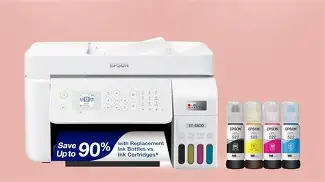
The ET-4800 removes the primary friction point of home printing—the fear of running out of ink. Throughout the month, the ink levels in the front-facing tanks barely moved, even after hundreds of pages of varied content. For the buyer who values long-term savings and reliability over flashy touchscreens and high-speed mechanical throughput, the ET-4800 is one of the most sensible investments in the electronics category. It is a workhorse that trades unnecessary frills for pure, economical utility. If you can live with manually turning over your pages for double-sided prints, you will be rewarded with years of trouble-free operation and some of the lowest running costs in the history of home computing.